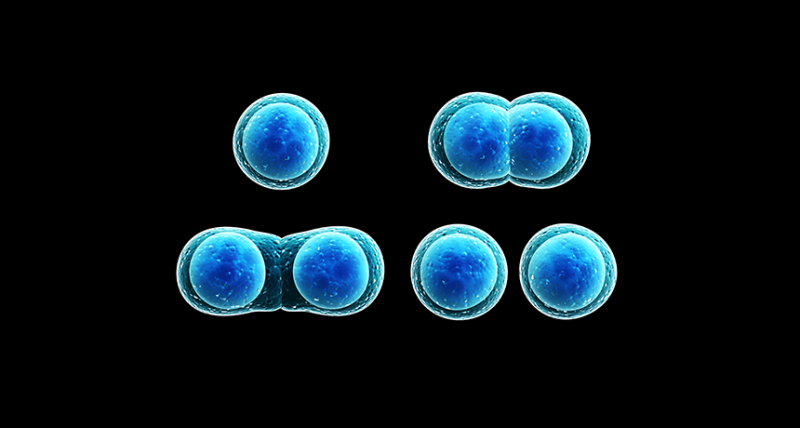
An average baby is generally not much taller than 50 centimeters after birth. However, over time his height increases, almost at a dizzying rate, until he reaches one meter at the age of four. The same happens with the child's mass, which increases from about 3.5kg at the time of delivery to 16kg when he reaches four years of age. How is it possible? Something must happen in the body of an infant so that, in a matter of just four years, it doubles its height and quintupled its mass. I anticipate that it is not a "engorgement" spell or any type of supernatural ability that only babies possess. What happens to babies at this stage is not different from what happens daily in our bodies: the cells have multiplied, giving rise to new cells. The difference is that, while in children, the process responsible for multiplying our cells acts at a frantic rate, in adults it is reduced. This process is known as "mitosis" which in biology, mitosis is a process that occurs in the nucleus of eukaryotic cells and immediately precedes cell division. It consists of the equitable distribution of the characteristic hereditary material.
Meiosis
While Meiosis is the formation of eggs and sperm. In organisms with sexual reproduction, the cells of the body are diploid, that is, they contain two sets of chromosomes (one from each parent). To maintain this state, the egg and sperm that come together during fertilization must be haploid, which means that each must contain a unique set of chromosomes. During meiosis, diploid cells replicate their DNA, followed by two rounds of cell division, producing four haploid sex cells, it is a really important part of human biology and the biology of many other organisms that have sexual reproduction. Basically, the problem is this: You have a certain number of chromosomes; we as humans have 46. But a child who is going to get half of his inheritance from his mother and father, cannot keep 46 of both - because it would be 92. So there has to be a way to take the paired chromosomes and separate them when producing gametes; sperm and eggs. That's what meiosis is all about. In taking that complete set and breaking it down into what we call a haploid set, providing the opportunity for both copies to mix a bit and result in mixed results, which is critical for the diversity of the species. Meiosis is one of those things that is hard to understand. There is meiosis 1, there is meiosis 2 ... you have to know where recomb


Comentarios
Publicar un comentario